Shoulder replacement for arthritis: 3D planning and results
When arthritis has worn away the cartilage of the shoulder, a replacement reliably relieves pain and restores motion. This page explains how Dr. Jiang plans each replacement in 3D before surgery and uses custom-printed guides to place the implants, and summarizes the results of anatomic and reverse total shoulder replacement for osteoarthritis.
Planning your shoulder before surgery
Arthritis often wears the socket (glenoid) unevenly, tilting it backward or eroding one side. Positioning the socket implant correctly on that worn bone is one of the hardest parts of the operation, and a poorly positioned socket component is one of the main reasons replacements loosen over time.1
- A CT scan of your shoulder is used to build a 3D model of your bones.
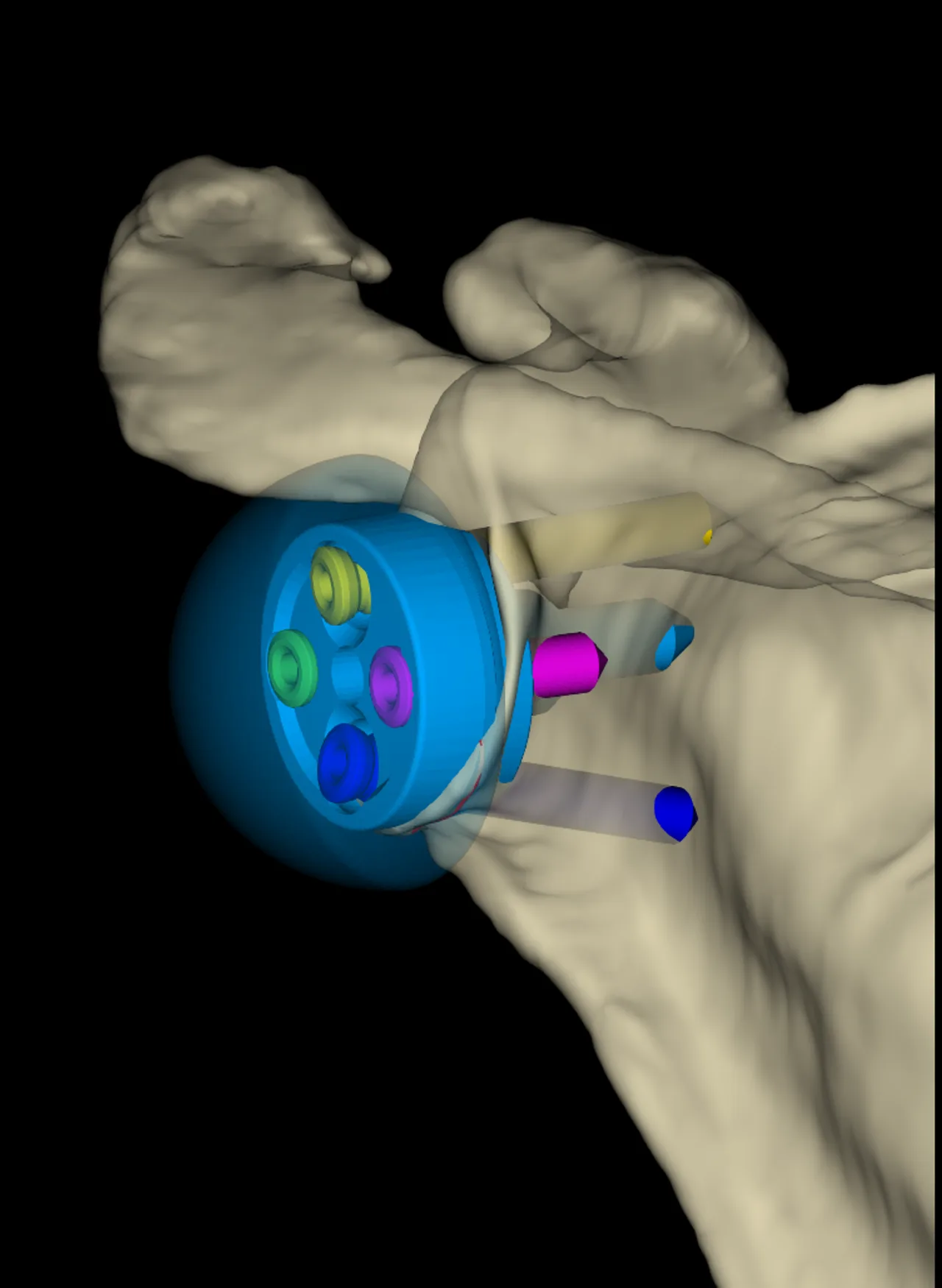
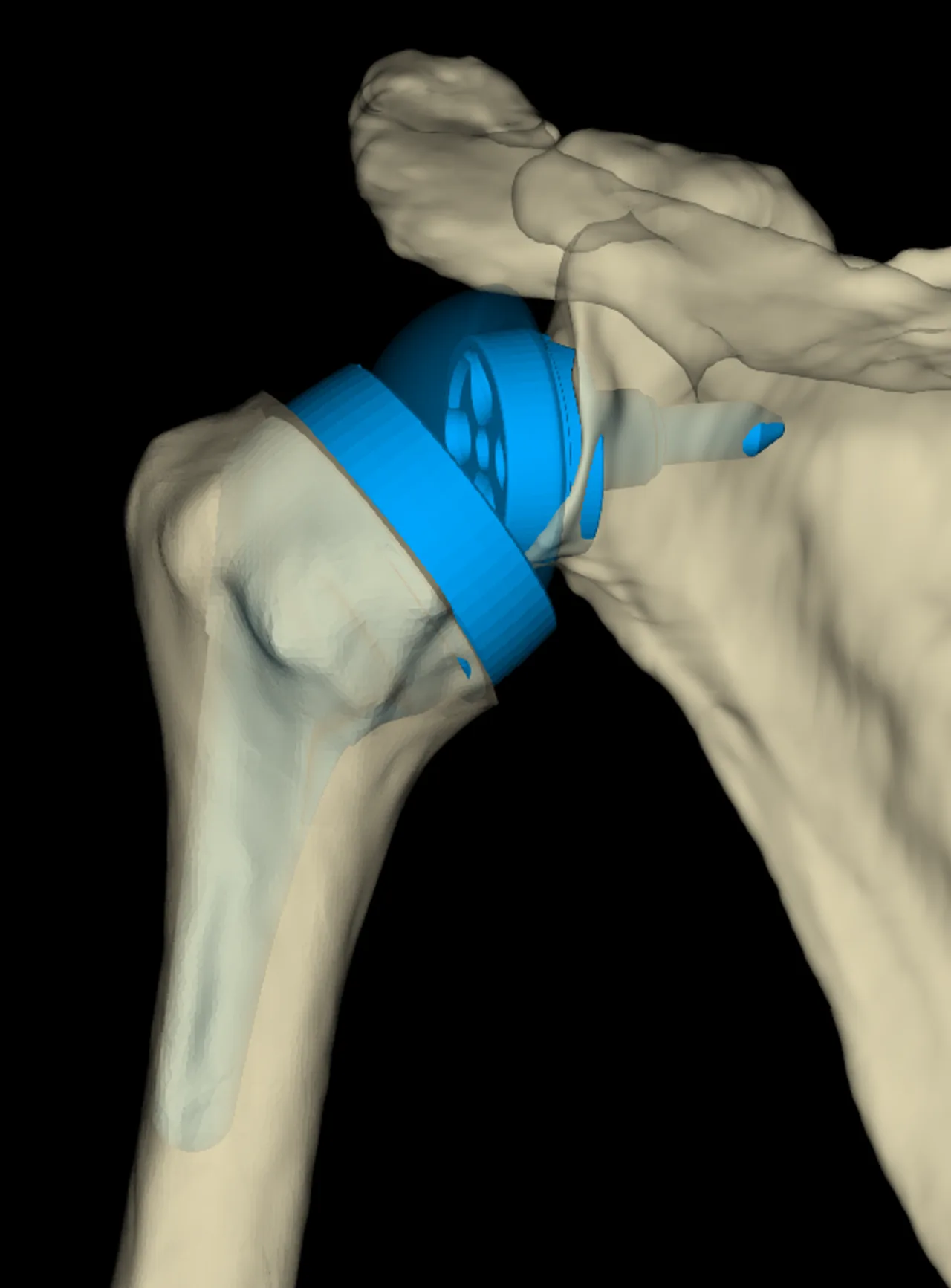
- A virtual plan measures the wear and tilt of the socket, and the implant size, angle, and position are chosen on the model before surgery.
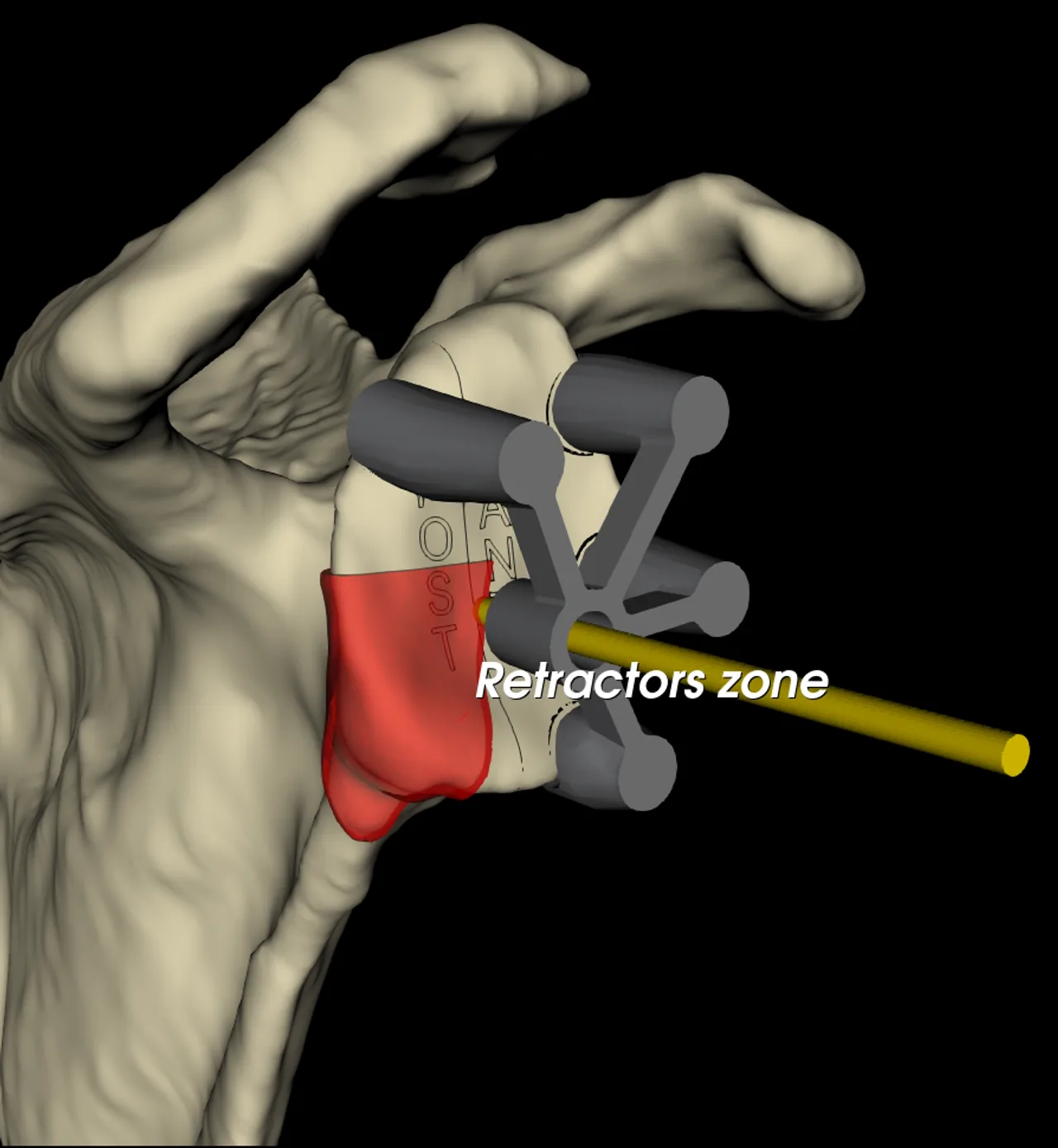
- A custom guide is 3D-printed from that plan. It fits only your shoulder, and during surgery it sets the guide pin in exactly the planned position.
What the research shows about accuracy
In a meta-analysis of 12 studies, custom guides placed the socket component significantly closer to the plan for version, tilt, and starting point than standard instruments, with far fewer badly placed implants.1 The benefit is greatest when the socket is badly worn or deformed.2 Not every study has found a difference,3 and it hasn't yet been proven that better accuracy leads to longer-lasting implants, though poor positioning is a known cause of failure.1,3
Results of anatomic replacement
An anatomic total shoulder replacement restores the normal shape of the joint, with a metal ball on the arm bone and a plastic socket. It needs a working rotator cuff.
Pain relief and function improve substantially in the first year and stay stable for many years, with high satisfaction.5,6 The main long-term concern is loosening or wear of the plastic socket, which is the most common reason for revision, especially in younger, more active patients.4
Results of reverse replacement for arthritis
A reverse shoulder replacement swaps the ball and socket, so the deltoid muscle can power the arm without depending on the rotator cuff. It is standard when the cuff is torn, and it is increasingly used for arthritis with an intact cuff, particularly in older patients and those with severe socket wear.
For arthritis with an intact rotator cuff, reverse and anatomic replacements give similar patient-reported results.7 Reverse replacement has had lower revision and reoperation rates in comparative studies,7 while anatomic replacement gives better rotation, such as reaching behind the back.7
Anatomic or reverse?
Request an Appointment Back to shoulder osteoarthritis
References
- 1Villatte G, et al. Use of patient-specific instrumentation (PSI) for glenoid component positioning in shoulder arthroplasty: a systematic review and meta-analysis. PLoS One. 2018;13(8):e0201759. Link →
- 2Patient-specific instrument guidance of glenoid component implantation reduces inclination variability in total and reverse shoulder arthroplasty. J Shoulder Elbow Surg. 2015. Link →
- 3Cabarcas BC, Cvetanovich GL, Gowd AK, et al. Accuracy of patient-specific instrumentation in shoulder arthroplasty: a systematic review and meta-analysis. JSES Open Access. 2019. Link →
- 4Bhatti F, Waseem S, Singh H, et al. Long-term survival outcomes following total shoulder arthroplasty: an implant-level systematic review and meta-analysis of case series and registry data with more than 13 years follow-up. Shoulder Elbow. 2026. Link →
- 5Patel AV, White CA, Schroen CA, et al. Anatomic total shoulder arthroplasty: long-term clinical, radiographic, and patient-reported outcomes. J Am Acad Orthop Surg. 2026;34(16):e2226–e2232. Link →
- 6The recovery curve of anatomic total shoulder arthroplasty for primary glenohumeral osteoarthritis: midterm results at a minimum of 5 years. J Shoulder Elbow Surg. 2022. Link →
- 7Gupta MS, et al. Reverse versus anatomic total shoulder arthroplasty in patients over 70 with a competent rotator cuff and glenohumeral osteoarthritis: a meta-analysis. J Shoulder Elbow Surg. 2026;35(5):1370–1386. Link →
This page summarizes published research for patient education. Study results describe groups of patients and may not apply to you. It is not a substitute for an evaluation and a discussion of your own shoulder.