Conditions we treat

Understand your injury.

Choose a condition to read what is damaged, how it is diagnosed, what to try before surgery, and how long recovery takes. These are the conditions we see most often, not a complete list of everything we treat. If yours is not here, call the office.

Shoulder

Labral & SLAP tear

Deep shoulder pain with overhead throwing or pressing, sometimes a clicking sensation.

What it is

A SLAP tear involves the top of the labrum where the biceps tendon anchors. It is common in throwers, swimmers, and overhead lifters, and also occurs from a fall onto an outstretched arm. Pain is felt deep in the joint, often with a loss of velocity or power rather than a discrete injury moment.

How it's diagnosed

Provocative exam tests help, though none is definitive on its own. An MRI arthrogram is the most useful study. Age matters: in patients over forty, labral fraying is common and often not the true pain source, so the exam has to drive the conclusion.

Non-surgical options first

Therapy addressing the whole kinetic chain — hip and trunk rotation, scapular control, posterior capsule tightness — resolves a large share of these, particularly in throwers, whose mechanics are often the underlying cause.

When surgery is the right call

Considered for a persistent, well-localized tear in a younger overhead athlete after a full therapy trial, or when the labral tear is accompanied by instability.

Dr. Jiang's approach

Arthroscopic repair in younger patients; biceps tenodesis — moving the biceps anchor out of the joint — is often the more reliable operation in patients over about thirty-five or when the biceps tendon itself is the pain generator.
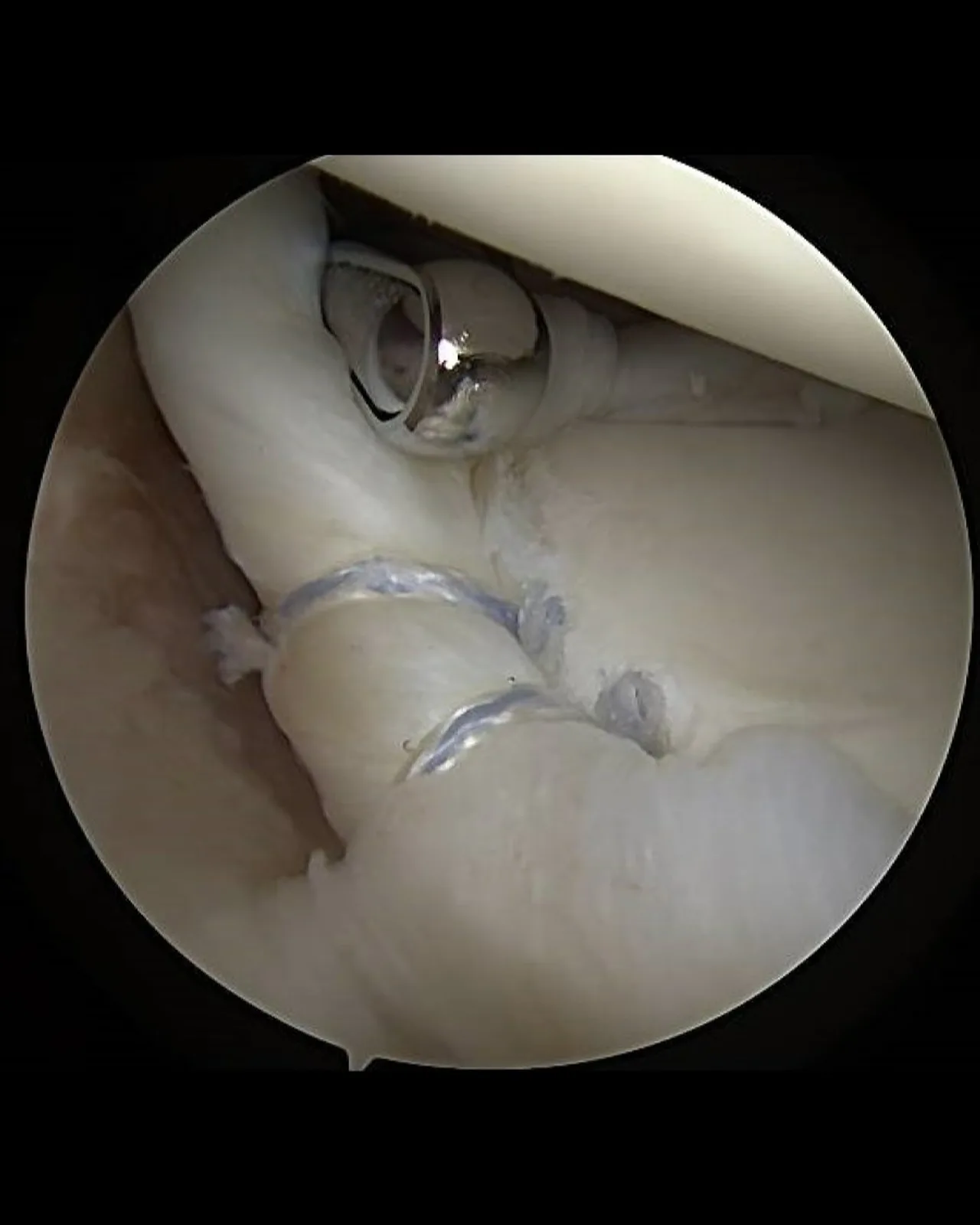
Arthroscopic SLAP repair
SLAP repair
SLAP repair The view through the arthroscope. The top of the labrum, where the biceps tendon anchors, has been secured back to the socket with sutures and absorbable anchors in the bone.
If surgery is needed — recovery timeline
Weeks 0–4
Sling, passive motion, biceps protected.
Weeks 4–10
Active motion and early strengthening.
Months 3–5
Rotator cuff and scapular strengthening, kinetic chain work.
Months 6–9
Interval throwing program; overhead athletes take the longest.
Typical ranges. Your timeline depends on the injury, the repair, and how rehab goes.
Questions to ask at your visit
  • Is the labrum really the source of my pain?
  • Repair or tenodesis for someone my age?
  • What in my mechanics is causing this?
Evidence review
SLAP tear: repair or biceps tenodesis? →
Satisfaction and return to sport after SLAP repair vs biceps tenodesis, with references.
Read more from the AAOS
SLAP Tears in the Shoulder →
A note on what you read here

These pages describe how these injuries are generally evaluated and treated. They are not a diagnosis and not medical advice. Two people with the same MRI finding can need completely different plans — that is what the visit is for.

Not sure which of these you have? That's the normal reason to come in.

Request an Appointment
Kevin Jiang, MD
Orthopaedic Surgery · Sports Medicine
English · Mandarin · Spanish
Accepting new patients
Locations
72-06 Northern Blvd, 2nd Fl
Jackson Heights, NY 11372

2825 Jackson Ave
Long Island City, NY 11101

(866) 670-6824
Fax: (718) 533-1770
Where surgery happens
NewYork-Presbyterian Queens
56-45 Main Street, 4th Fl South
Flushing, NY 11355
(718) 670-2558
Hospital affiliations: NewYork-Presbyterian Queens; NewYork-Presbyterian / Columbia University Irving Medical Center; Hospital for Special Surgery (Affiliate Medical Staff). Institutional names denote affiliation, not endorsement.
This site is for informational purposes only and does not constitute medical advice. Use of this site does not create a doctor-patient relationship. For emergencies call 911.
© 2026 Kevin Jiang, MD