Understand your injury.
Choose a condition to read what is damaged, how it is diagnosed, what to try before surgery, and how long recovery takes. These are the conditions we see most often, not a complete list of everything we treat. If yours is not here, call the office.
Elbow osteoarthritis
Pain at the ends of the range — straightening or fully bending — with grinding and sometimes a locking catch.
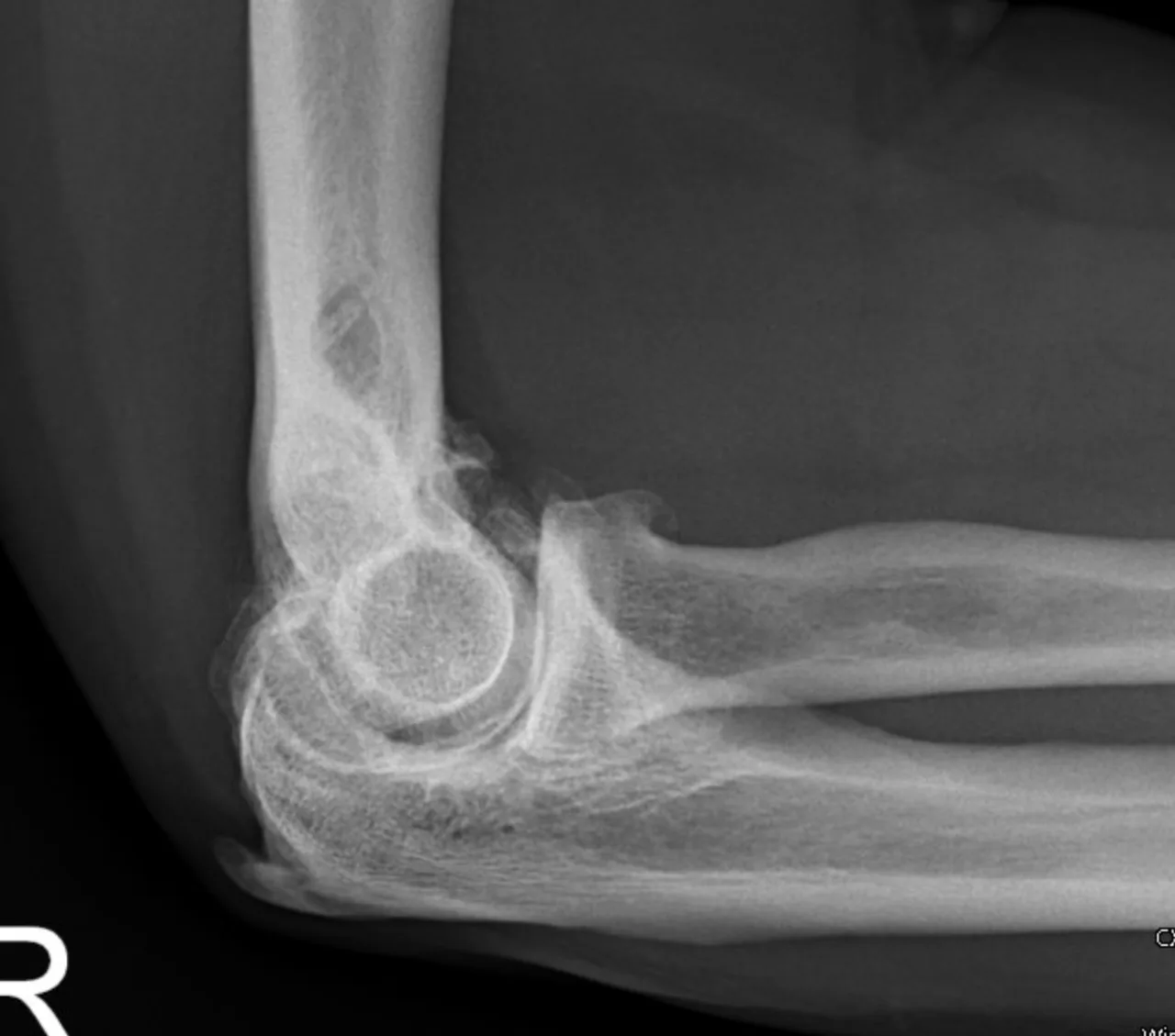
Elbow arthritis behaves differently from arthritis in the knee or hip. It tends to hurt most at the extremes of motion rather than through the middle, so the first complaint is usually losing the last stretch of extension rather than pain with everyday use. Bone spurs build up at the front and back of the joint and block motion mechanically, and loose fragments can break off and cause true locking. It is most common in men who have done heavy manual work, in throwers, and after a previous elbow fracture or dislocation.
The exam measures how much extension and flexion have been lost and whether the block feels bony and hard or soft. The ulnar nerve is checked, because it runs through a joint that is getting tighter and is frequently irritated in elbow arthritis. X-rays show the spurs and joint space; CT maps the spurs precisely and locates loose bodies before surgery.
Activity modification away from repetitive heavy loading, anti-inflammatories, a gentle motion program, and a corticosteroid injection. Notably, formal stretching rarely regains motion lost to a bony block — if bone is in the way, therapy will not move it.
Considered when motion loss interferes with daily tasks, when loose bodies cause locking, or when pain persists despite non-surgical care. Because the driver is usually mechanical rather than cartilage-wide, surgery here often has more to offer than in other arthritic joints.
Arthroscopic debridement: the spurs are removed, loose bodies are retrieved, and the contracted capsule is released to restore motion — a joint-preserving operation that most patients do well with. Ulnar nerve decompression is added when nerve symptoms are present. Total elbow replacement is reserved for advanced, low-demand cases and carries permanent lifting restrictions.
- How much of my lost motion is bone and how much is soft tissue?
- Is my ulnar nerve involved?
- How long is the motion likely to last after a debridement?
These pages describe how these injuries are generally evaluated and treated. They are not a diagnosis and not medical advice. Two people with the same MRI finding can need completely different plans — that is what the visit is for.