Conditions we treat

Understand your injury.

Choose a condition to read what is damaged, how it is diagnosed, what to try before surgery, and how long recovery takes. These are the conditions we see most often, not a complete list of everything we treat. If yours is not here, call the office.

Knee

Meniscus root tear

A pop with a deep squat or twist, pain at the back of the knee, and a knee that never quite settles down.

What it is

Each meniscus is anchored to the shin bone at its front and back ends, called the roots. When a root tears, the meniscus can no longer hold its shape under load — it slides out of the joint and stops working as a cushion. Biomechanically, a complete root tear behaves almost like having no meniscus at all, and the cartilage on that side of the knee can wear down quickly. Root tears happen in younger patients with ACL injuries and, very commonly, in middle-aged patients from a simple squat or twist, often with a painful pop at the back of the knee.

How it's diagnosed

The exam can be subtle: pain along the back of the joint line and difficulty with deep bending. MRI is key and shows the tear at the root along with the meniscus pushed out of the joint (extrusion). Early diagnosis matters, because the window to repair a root tear before arthritis sets in is limited.

Non-surgical options first

Activity modification, anti-inflammatories, injections, and therapy can help symptoms, and are the right choice when significant arthritis is already present or the patient is not a candidate for repair. They do not, however, restore the meniscus's function, and in many patients the knee continues to wear.

When surgery is the right call

Repair is recommended for an acute or subacute root tear in a knee without advanced arthritis, especially in younger and active patients, and whenever a root tear occurs together with an ACL tear. Early repair gives the best chance of protecting the cartilage.

Dr. Jiang's approach

Arthroscopic root repair with a suture anchor: sutures are passed through the torn root, and a special anchor is placed in the bone right at the root's original attachment on the shin bone. Knotless sutures then pull the root down and hold it firmly against the bone. This restores the meniscus to where it belongs so it can heal and share load again.
Root repair, and why it matters
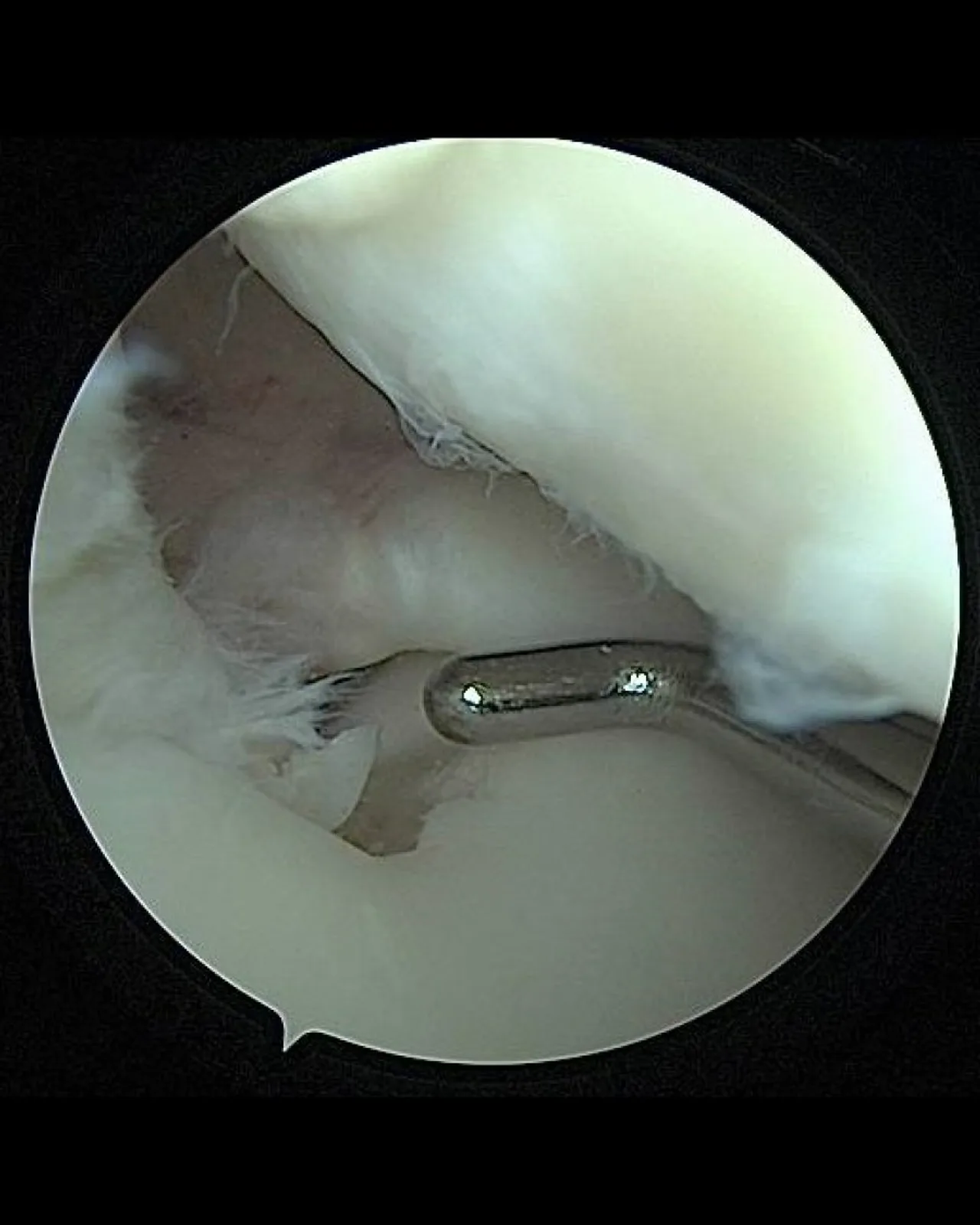
Before: root tear
Before: root tear The view through the arthroscope. The probe lifts the torn root, which has come loose from its attachment on the shin bone.
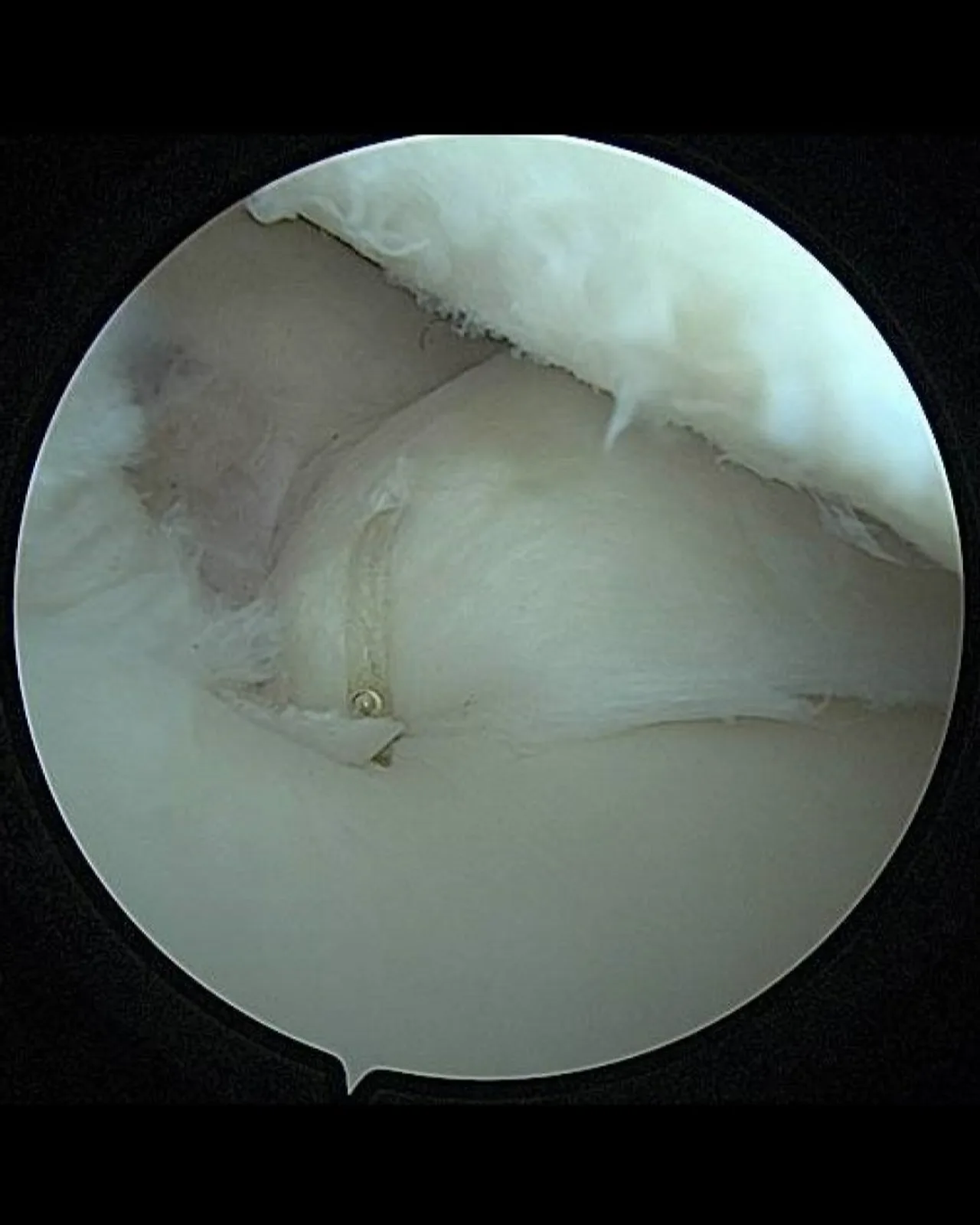
After: root repair
After: root repair The root has been repaired back to bone with an anchor placed right at its attachment and knotless sutures, so the meniscus can hold its shape and share load again.
Five years later: repaired vs. missed
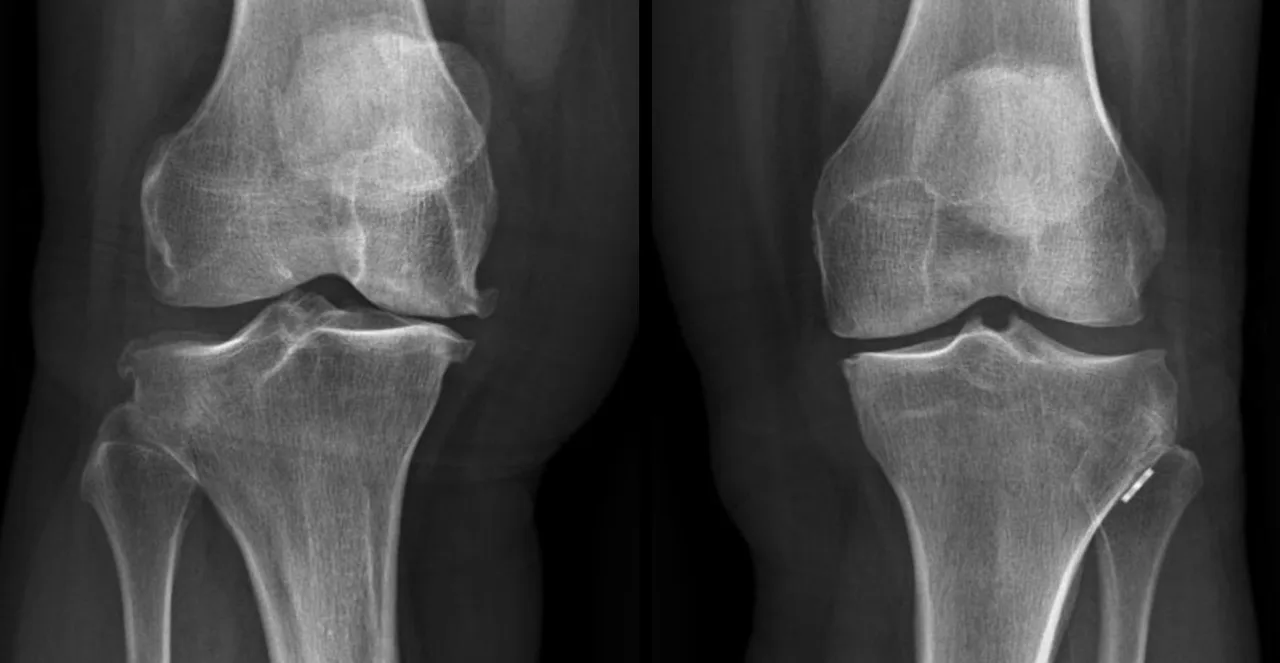
Five years later: repaired vs. missed Standing X-rays of the same patient. The left knee (right side of the image, with the small button on the shin) had a root repair and still has a healthy joint space. The right knee had a root tear that was missed, and the inner side has since collapsed into advanced arthritis.
If surgery is needed — recovery timeline
Weeks 0–6
Non-weight-bearing or touch-down weight-bearing on crutches in a brace; flexion limited to protect the repair.
Weeks 6–12
Progress to full weight-bearing, normal walking, and full range of motion; strengthening begins.
Months 3–5
Progressive strengthening; avoid deep squatting under load.
Months 5–6
Return to running and sport once strength and control are restored.
Typical ranges. Your timeline depends on the injury, the repair, and how rehab goes.
Questions to ask at your visit
  • Is my root tear complete, and how far has the meniscus extruded?
  • How much arthritis is already on that side of my knee?
  • Is my root tear repairable?
Evidence review
Meniscus root repair: healing, results, and who does best →
Repair vs meniscectomy vs no surgery, healing rates, and risk factors for failure, with references.
Read more from the AAOS
Meniscus Tears →
A note on what you read here

These pages describe how these injuries are generally evaluated and treated. They are not a diagnosis and not medical advice. Two people with the same MRI finding can need completely different plans — that is what the visit is for.

Not sure which of these you have? That's the normal reason to come in.

Request an Appointment
Kevin Jiang, MD
Orthopaedic Surgery · Sports Medicine
English · Mandarin · Spanish
Accepting new patients
Locations
72-06 Northern Blvd, 2nd Fl
Jackson Heights, NY 11372

2825 Jackson Ave
Long Island City, NY 11101

(866) 670-6824
Fax: (718) 533-1770
Where surgery happens
NewYork-Presbyterian Queens
56-45 Main Street, 4th Fl South
Flushing, NY 11355
(718) 670-2558
Hospital affiliations: NewYork-Presbyterian Queens; NewYork-Presbyterian / Columbia University Irving Medical Center; Hospital for Special Surgery (Affiliate Medical Staff). Institutional names denote affiliation, not endorsement.
This site is for informational purposes only and does not constitute medical advice. Use of this site does not create a doctor-patient relationship. For emergencies call 911.
© 2026 Kevin Jiang, MD