Understand your injury.
Choose a condition to read what is damaged, how it is diagnosed, what to try before surgery, and how long recovery takes. These are the conditions we see most often, not a complete list of everything we treat. If yours is not here, call the office.
Knee malalignment & osteotomy
Pain on one side of the knee, often with a bow-legged or knock-kneed alignment, in someone too young or active for a knee replacement.
When the leg is not straight — bow-legged (varus) or knock-kneed (valgus) — body weight is carried unevenly, overloading one side of the knee. Over time that side wears faster, causing pain and early arthritis in just one compartment while the rest of the knee stays healthy. Malalignment can also overload a cartilage repair or meniscus transplant and cause it to fail. At the kneecap, a tibial tubercle osteotomy is used to realign the patella in some cases of recurrent dislocation or cartilage wear behind the kneecap.
The exam assesses alignment, stability, and where the pain is. Full-length standing X-rays of both legs measure exactly how the weight-bearing line passes through the knee. MRI evaluates the cartilage and meniscus on each side, since osteotomy works best when the opposite side of the knee is still healthy.
Activity modification, strengthening, weight optimization, an unloader brace that shifts pressure to the healthier side, and injections can reduce symptoms and are always tried first.
Considered for a younger, active patient with pain from one overloaded compartment, a measurable malalignment, and a healthy opposite side — or when correcting alignment is needed to protect a cartilage, meniscus, or ligament reconstruction.
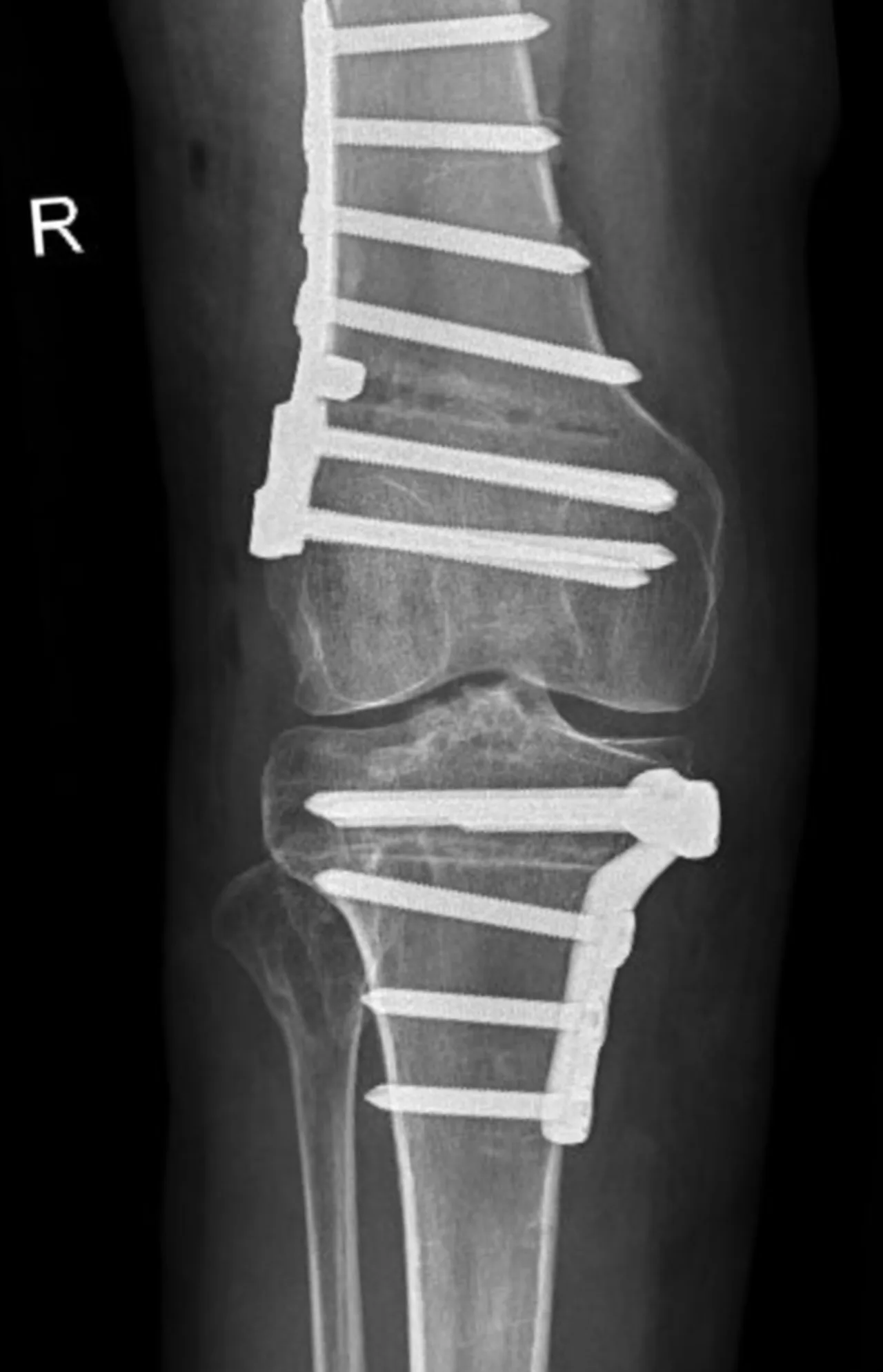
An osteotomy is a controlled cut in the bone, usually the upper tibia (high tibial osteotomy) or lower femur (distal femoral osteotomy), which is then opened or closed by a precisely planned amount and held with a plate and screws. This shifts weight onto the healthier side of the knee. The goal is to preserve your own joint and delay or avoid a knee replacement. It is often combined with cartilage or meniscus procedures in the same operation.
- How far off is my alignment, and on which side?
- Is the other side of my knee healthy enough for this to work?
- How does this compare with a partial or total knee replacement for me?
These pages describe how these injuries are generally evaluated and treated. They are not a diagnosis and not medical advice. Two people with the same MRI finding can need completely different plans — that is what the visit is for.