Understand your injury.
Choose a condition to read what is damaged, how it is diagnosed, what to try before surgery, and how long recovery takes. These are the conditions we see most often, not a complete list of everything we treat. If yours is not here, call the office.
Achilles tendon rupture
A sudden pop or a feeling of being kicked in the back of the ankle — and you can't push off.
The Achilles is the largest tendon in the body and takes several times body weight with every push-off. It usually ruptures in a middle-aged recreational athlete during a sudden acceleration — a first step in basketball, a serve, a sprint for a bus. People often describe being struck from behind and turning around to find no one there. Walking is still possible using other muscles, which is why as many as one in four are missed on first presentation. Pushing off, climbing stairs, or standing on that toe are not.
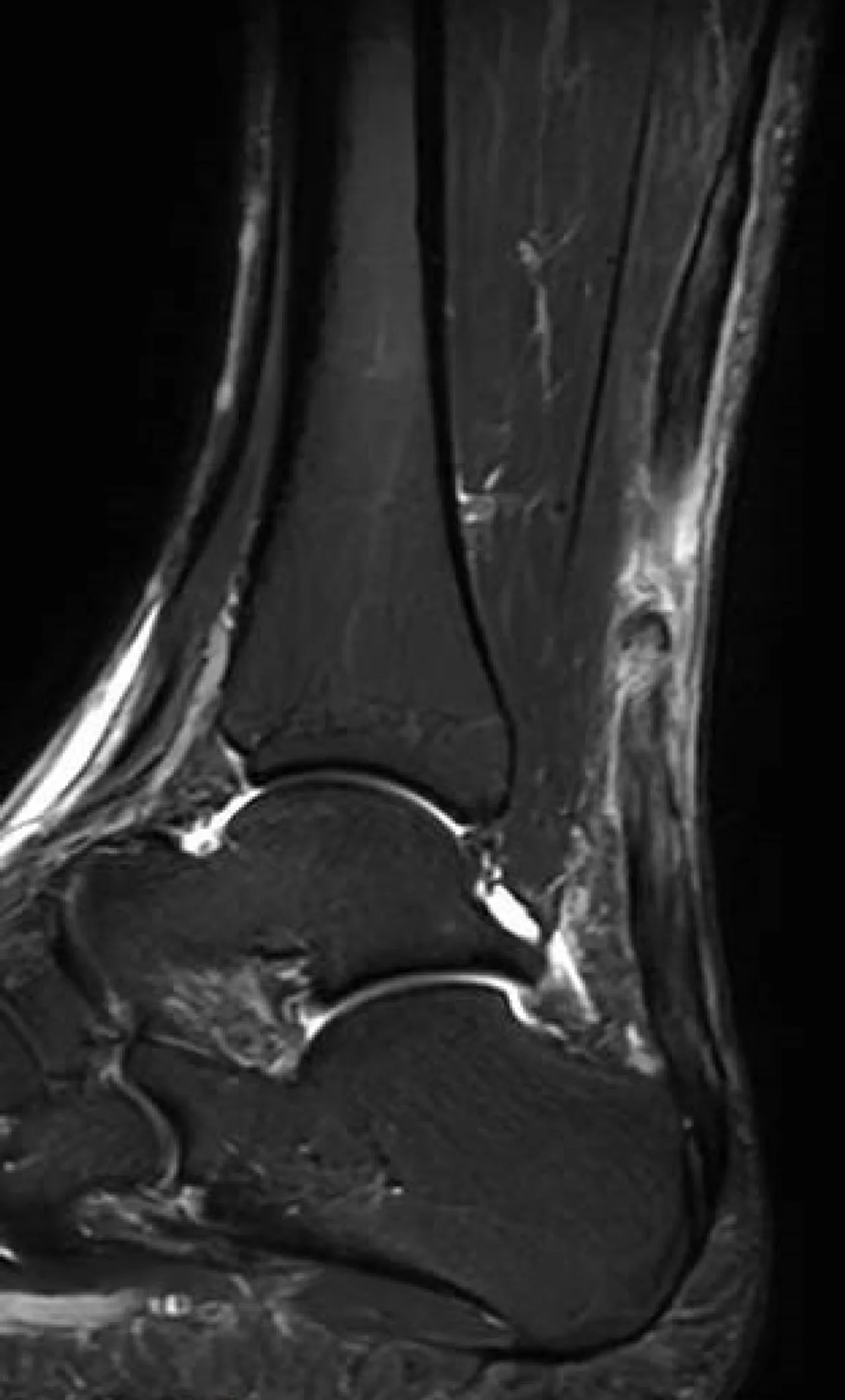
The Thompson test is the key exam: with you lying face down, squeezing the calf should point the foot down — with a complete rupture, it does not. A palpable gap in the tendon two to six centimeters above the heel is common. Ultrasound or MRI confirms the rupture, measures the gap, and shows how much healthy tendon remains.
Functional bracing with early weight-bearing and a structured rehabilitation protocol has narrowed the gap in re-rupture rates with surgery, with none of the wound risk, although re-rupture is still somewhat more common than after repair. It is a genuine option, particularly for older or lower-demand patients and for anyone who has diabetes or vascular disease or who smokes. It requires strict adherence to the boot and heel-wedge schedule.
Favored for higher-demand and athletic patients, for large tendon gaps, for delayed presentations, and where the priority is maximizing push-off strength. Repair done within the first two to three weeks is technically much simpler than a chronic reconstruction.
Repair of the tendon ends, performed through a limited or percutaneous incision where the tear pattern allows, to reduce wound complications. The repair is protected in a boot and the rehabilitation is started early — motion and loading, appropriately timed, are what restore tendon strength.
- Is bracing a reasonable option for someone my age and activity level?
- How big is the gap in the tendon?
- What is my re-rupture risk either way?
These pages describe how these injuries are generally evaluated and treated. They are not a diagnosis and not medical advice. Two people with the same MRI finding can need completely different plans — that is what the visit is for.