Understand your injury.
Choose a condition to read what is damaged, how it is diagnosed, what to try before surgery, and how long recovery takes. These are the conditions we see most often, not a complete list of everything we treat. If yours is not here, call the office.
MCL & posteromedial corner (POL) injury
Pain on the inner side of the knee after the knee is pushed inward, often in contact sports or skiing.
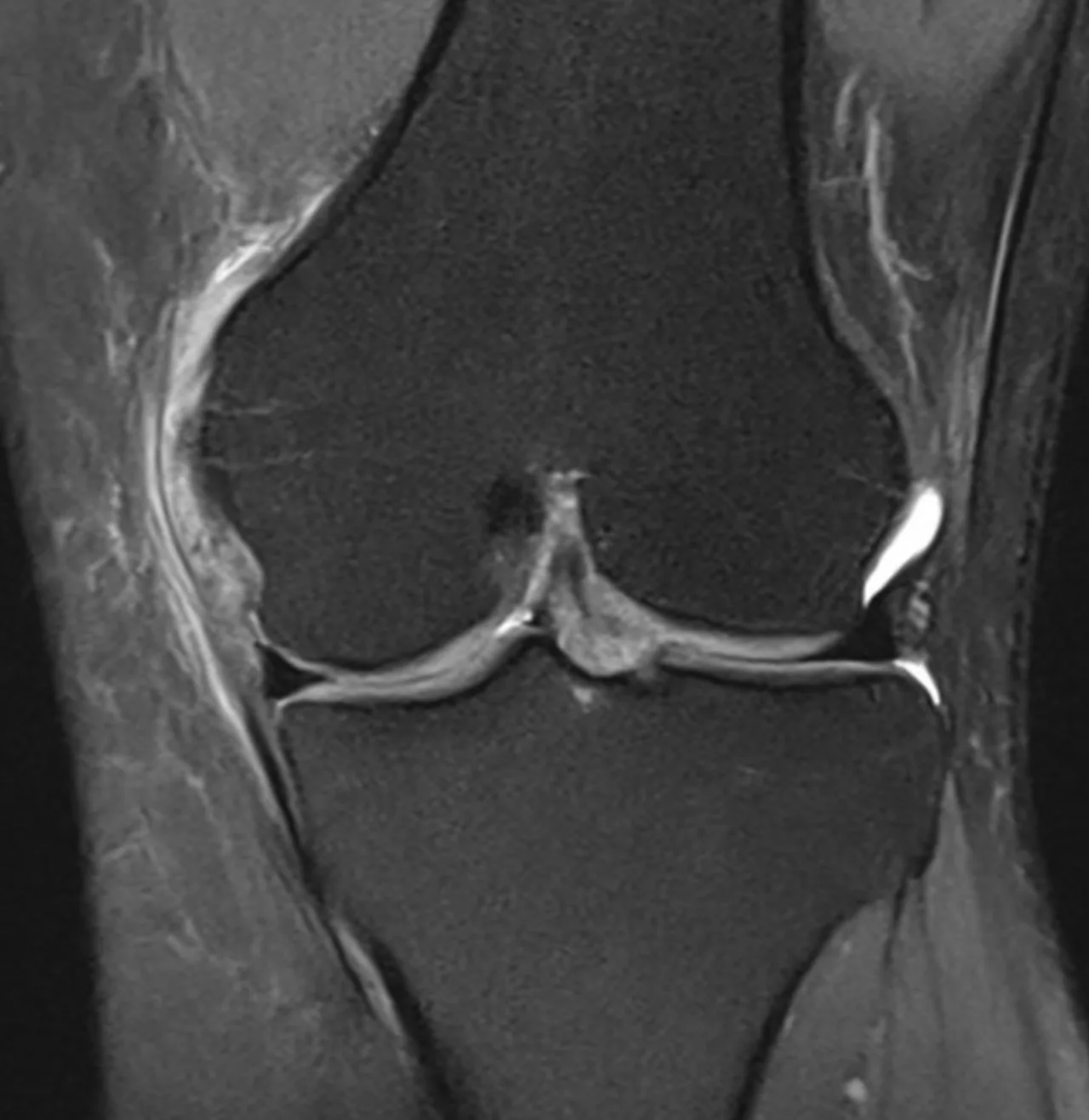
The medial collateral ligament (MCL) runs along the inner side of the knee and keeps it from bending inward. Behind it, the posterior oblique ligament (POL) and the other structures of the posteromedial corner add stability, especially when the knee is straight and twisting. The MCL is the most commonly injured knee ligament. Injuries are graded I to III, from a stretch to a complete tear. Most MCL tears heal on their own because the ligament has a good blood supply.
On exam, the knee is gently pushed inward to see how much it opens compared with the other side, both bent and straight. Opening with the knee straight suggests the POL is also injured. X-rays rule out fractures, and MRI shows the location and severity of the tear and whether the ACL, meniscus, or other ligaments are involved.
Grade I and II injuries, and many isolated grade III MCL tears, heal well in a hinged knee brace with early motion and physical therapy. Most people return to sport within several weeks to a few months.
Surgery is considered when the MCL and POL are torn together and the knee opens even when straight, when the ligament is torn off the bone and trapped in a position where it cannot heal, when other ligaments such as the ACL are also torn, or when the inner knee stays unstable after bracing. When the MCL is torn together with the ACL, we generally wait until the MCL has healed in a brace before performing ACL surgery.
Repair of the torn ligament back to bone, or reconstruction with a tendon graft for the MCL and POL, often done at the same time as other ligament surgery.
- What grade is my MCL injury?
- Is the POL also involved?
- Will a brace be enough, or do I need surgery?
These pages describe how these injuries are generally evaluated and treated. They are not a diagnosis and not medical advice. Two people with the same MRI finding can need completely different plans — that is what the visit is for.