Understand your injury.
Choose a condition to read what is damaged, how it is diagnosed, what to try before surgery, and how long recovery takes. These are the conditions we see most often, not a complete list of everything we treat. If yours is not here, call the office.
Quadriceps tendon rupture
The knee gives way coming down stairs, and you cannot straighten the leg or stand on it.
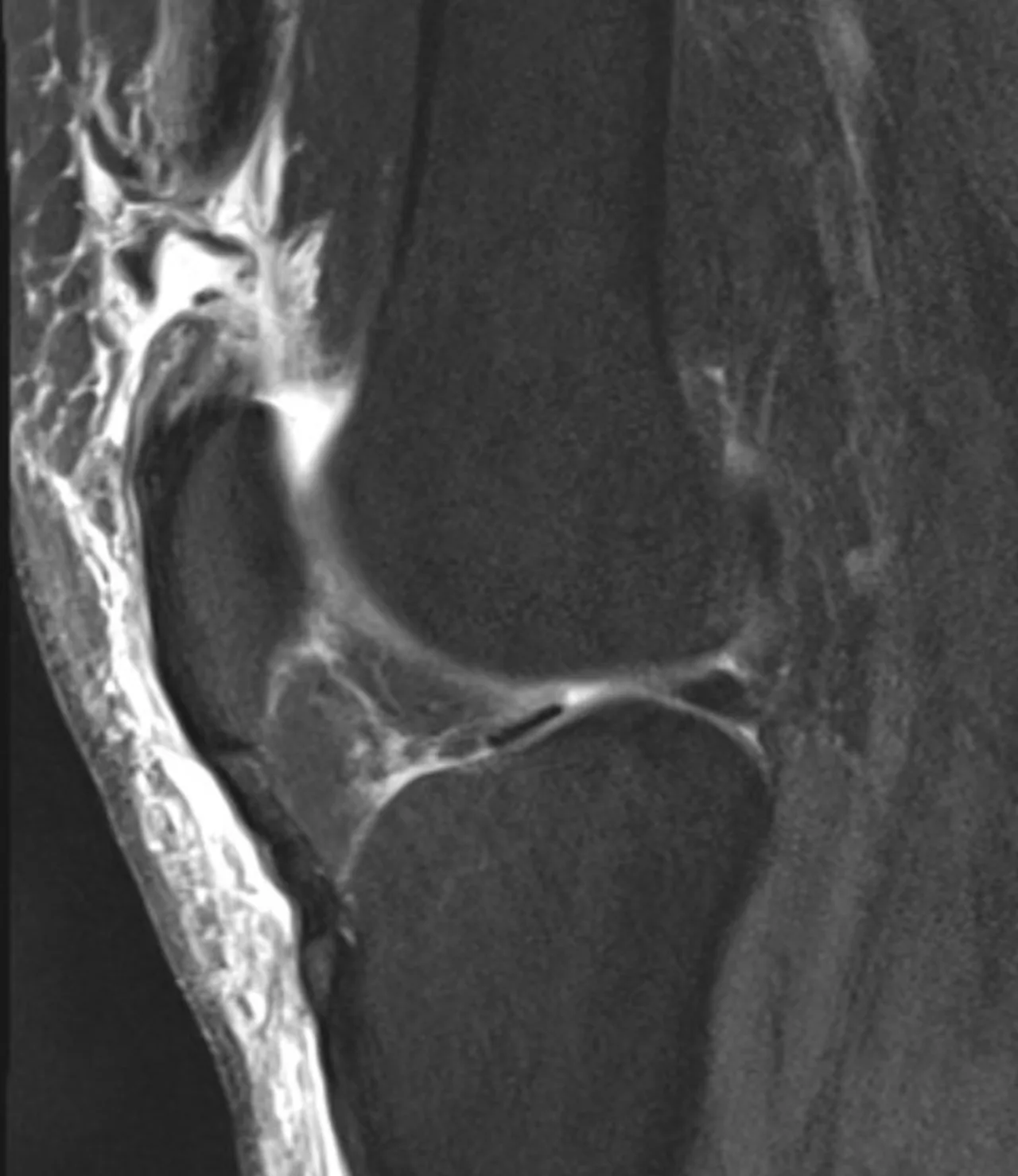
The quadriceps tendon connects the thigh muscles to the top of the kneecap and is the upper half of the extensor mechanism. It ruptures most often in patients over forty during an eccentric load — descending stairs, a stumble, a missed step — and, like the patellar tendon, it breaks your ability to straighten the knee. A palpable gap above the kneecap is common, and the kneecap may sit lower than on the other side. Risk is higher with diabetes, kidney disease, chronic steroid use, and prior tendon degeneration.
The decisive question is whether you can actively straighten the knee or hold it extended against gravity — with a complete rupture, you cannot. X-rays show the kneecap sitting low and rule out an avulsion fracture. Ultrasound or MRI confirms the tear, measures the gap, and shows how much healthy tendon remains.
Only appropriate for a partial tear where the extensor mechanism is intact and a straight leg raise is possible, treated in a brace locked in extension with a progressive quadriceps program.
A complete rupture requires repair, and sooner is substantially better. These are frequently missed at first presentation because patients can still walk stiff-legged; a delay of months turns a straightforward repair into a reconstruction.
The tendon is repaired back to the top of the kneecap. Dr. Jiang uses suture anchors, small implants placed in the bone that hold strong sutures, rather than drilling tunnels through the kneecap. This gives a stronger repair, so protected motion can begin early. Outcome depends closely on how early the repair is done and on following the quadriceps rehabilitation program.
- Can I actively straighten my leg — and what does that mean for me?
- How soon does this need to be repaired?
- What quad strength do I need before I'm cleared?
These pages describe how these injuries are generally evaluated and treated. They are not a diagnosis and not medical advice. Two people with the same MRI finding can need completely different plans — that is what the visit is for.