Understand your injury.
Choose a condition to read what is damaged, how it is diagnosed, what to try before surgery, and how long recovery takes. These are the conditions we see most often, not a complete list of everything we treat. If yours is not here, call the office.
Ankle fracture
A rolled ankle that swells immediately and cannot take weight.
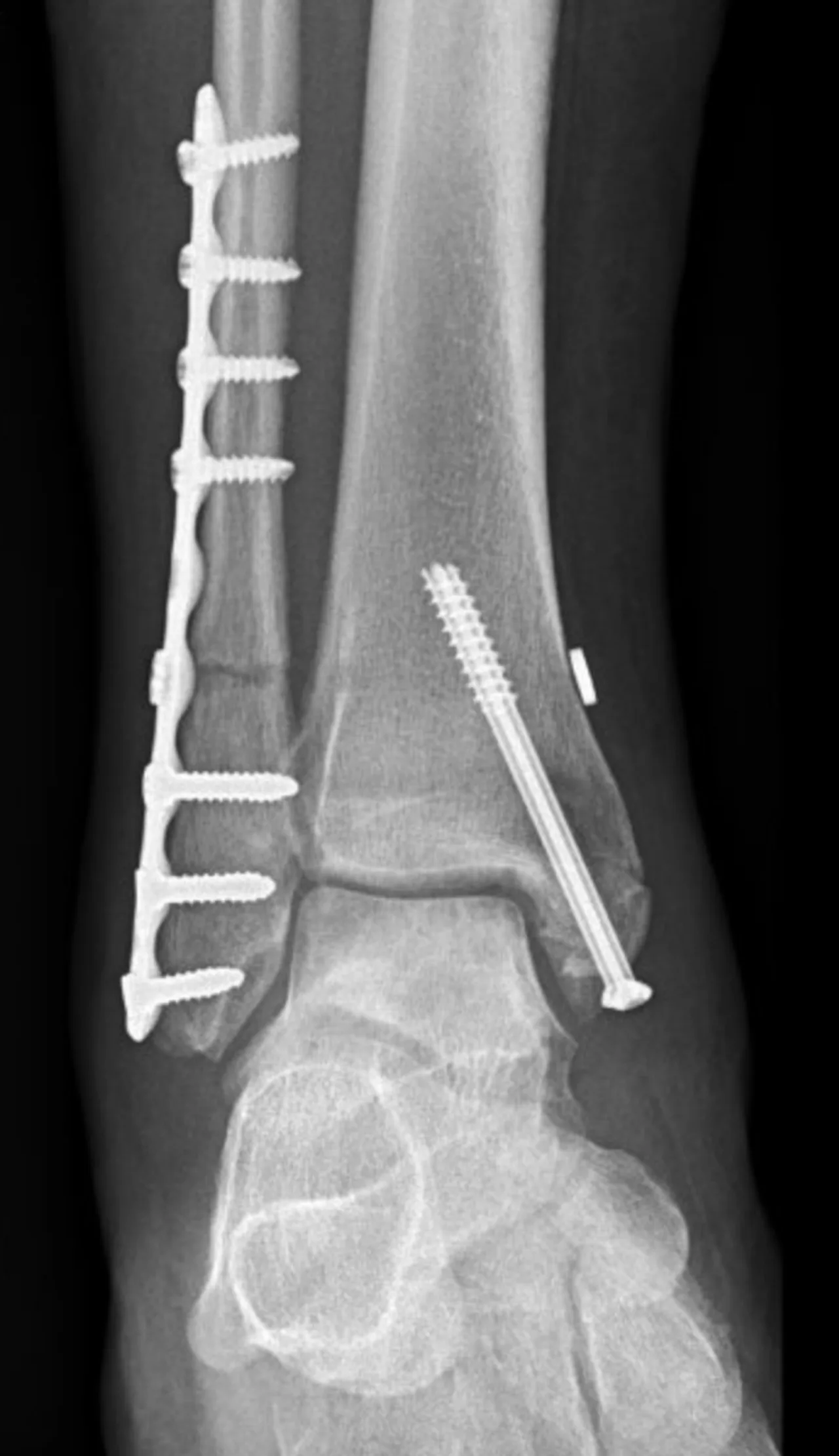
Ankle fractures range from a simple break of one malleolus to injuries involving two or three bones plus the ligaments that hold the two leg bones together. What decides treatment is not the fracture line itself but whether the ankle joint remains congruent and stable — a millimeter of shift changes contact pressures across the joint substantially.
X-rays are taken in three views, sometimes with stress views to test stability. CT is used for complex or intra-articular patterns.
Stable, non-displaced fractures are treated in a boot or cast with a defined weight-bearing protocol and interval X-rays to confirm nothing shifts.
Displaced or unstable fractures, any disruption of the syndesmosis, and fractures involving the joint surface are fixed operatively to restore the joint precisely.
Open reduction and internal fixation with plates and screws, with syndesmotic fixation when required. The goal is anatomic restoration of the joint surface — this is what determines arthritis risk a decade later.
- Is my ankle stable?
- Is the joint surface itself involved?
- When can I put weight on it, and when can I drive?
These pages describe how these injuries are generally evaluated and treated. They are not a diagnosis and not medical advice. Two people with the same MRI finding can need completely different plans — that is what the visit is for.